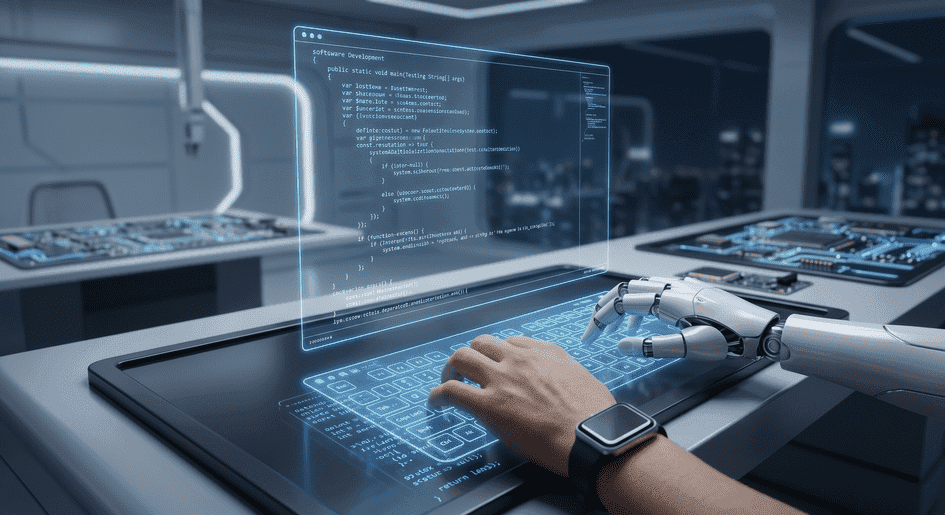
The landscape of software engineering is undergoing its most profound transformation since the invention of the high-level language. It feels like only yesterday we were marveling at simple tab-completion. Now, we stand at the precipice of "autopilot" development, led by a new generation of sophisticated AI coding agents.
The Evolution: From Code Completion to Contextual Understanding
We started with basic autocomplete: static dictionary lookups that saved a few keystrokes. Then came LLM-powered autocompletion (like GitHub Copilot's initial release). This was a game-changer, using patterns learned from vast repositories to suggest entire functions or complex code blocks in real-time.
But the limitation was always context. The AI saw your current file, perhaps a few surrounding files, but it lacked the deep, holistic understanding of the entire system architecture, the business logic, and the intricate dependencies that define modern applications.
The Rise of the AI Coding Agent (The 2026 Paradigm)
In 2026, we've moved past simple assistants. We now have AI Coding Agents.
An AI coding agent, exemplified by tools integrated directly into environments like Cursor or advanced setups utilizing models like Claude 3.5 Sonnet, is fundamentally different. It doesn't just suggest; it acts.
Key Capabilities of the Modern AI Agent:
Repository-Aware Context: The agent doesn't just read your current file. It indexes the entire codebase. It understands that changing a utility function in
src/utils/math.tsmight break a component insrc/components/Dashboard/Chart.tsx.Autonomous Execution: An agent can take a high-level instruction ("Implement a new user authentication flow using JWTs") and generate the necessary files, models, controllers, and tests. It can run shell commands, create PRs, and even deploy to a staging environment.
Complex Refactoring & Debugging: Agents are increasingly adept at tasks that were once exclusively senior-level territory. They can identify code smells, suggest optimal design patterns, and, perhaps most impressively, analyze failing stack traces to identify and fix the root cause of a bug, even spanning multiple microservices.
The Practical Shift: AI Orchestration, Not Autonomy
The most crucial insight for developers today is this: the goal isn't necessarily to replace the human developer, but to elevate them. The defining skill of a senior engineer in 2026 is AI Orchestration.
The human developer is the architect, the strategist, and the final arbiter of quality and safety. The AI agent is the incredibly powerful, inexhaustible junior-to-mid-level developer that can execute tasks with blistering speed.
Working with an Agent: A Workflow Sample
Human: "Agent, we need to add a 'forgot password' feature. Please create the backend endpoints, the database migration for the token, and a simple React component for the request form."
Agent: (Executes, creating files and logic.) "Done. Here are the files. I noticed you're using Prisma, so I created the migration file for you. I also added basic validation. Shall I run the tests?"
Human: (Reviews code, makes crucial design tweaks, e.g., enforcing a specific token expiry policy.) "Yes, run the tests and then open a draft PR."
The Challenges: Technical Debt and Ethics
This power is not without risk. Blindly accepting AI code can lead to a surge in technical debt. Agents can generate code that works but is unmaintainable, inefficient, or, most critically, insecure. The "security footgun" risk is magnified when the AI is empowered to write its own SQL or make network calls.
Furthermore, issues of copyright, licensing, and ethical code attribution remain complex. The code the agent generates is based on its training data; developers must ensure their use of AI aligns with corporate security and compliance policies.
Conclusion
The shift from autocomplete to autopilot is a massive leap forward. It unlocks productivity and allows developers to focus on the truly unique human aspects of software creation: architecture, product strategy, and user empathy. The future belongs not to the coder who can type the fastest, but to the engineer who can most effectively orchestrate their AI agent to build faster, smarter, and safer systems.
Comments (0)
Login to join the conversation
No comments yet. Be the first to share your thoughts!