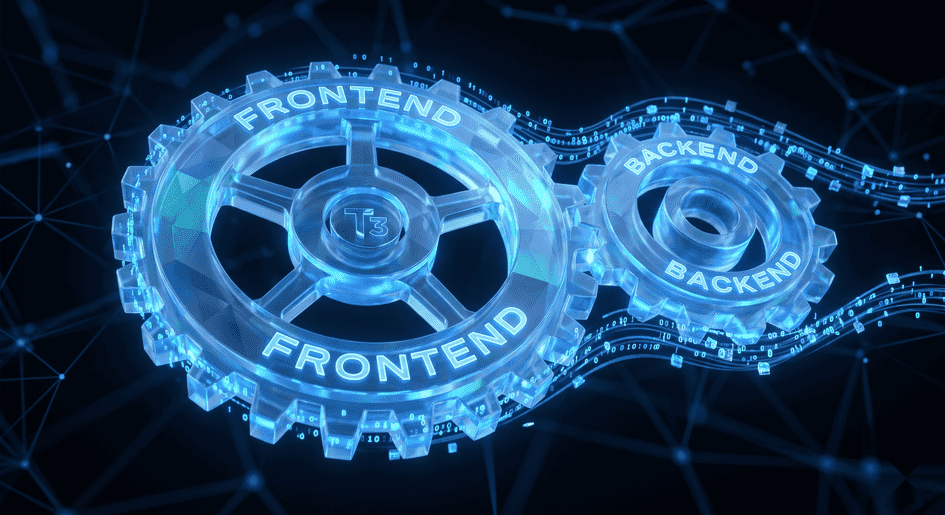
In the fast-paced world of web development, we are constantly searching for ways to build faster, reduce bugs, and enhance the overall developer experience (DX). Enter the T3 Stack—not just a combination of popular tools, but a philosophy built around the idea that comprehensive Type Safety is the catalyst for modern, robust application development.
By extending TypeScript from the database to the browser, the T3 Stack removes the guesswork between the frontend and backend, offering a unified, robust framework. Here is why the T3 philosophy is dominating software engineering conversations in 2026.
1. The Core Components
The T3 Stack isn't just a grab-bag of technologies; it’s a highly opinionated, cohesive unit designed to work together perfectly. The stack is founded on the principles of simplicity, modularity, and, above all, end-to-end type safety.
Next.js: The framework providing server-side rendering (SSR), static site generation (SSG), and the overarching routing structure.
Tailwind CSS: For utility-first, rapid, and maintainable UI styling.
TypeScript: The indispensable foundation that enforces strict typing across the entire stack.
Prisma: A type-safe Object-Relational Mapper (ORM) that makes interacting with your database feel like working with native JavaScript objects.
tRPC: The secret ingredient that creates a "Zero-API" experience. It lets you call backend functions directly from your frontend with full type inference, eliminating the need for a traditional REST or GraphQL layer.
2. The "Zero-API" Revolution with tRPC
The traditional method of full-stack communication relies on a strict contract between the client and the server. If the backend renames a field from user_id to id, the frontend often doesn't find out until a runtime error occurs in production.
In a T3 application, tRPC eliminates this risk. It bridges the gap by sharing type definitions directly from your server-side functions to your client-side code.
No Code Generation: Unlike GraphQL or OpenAPI/Swagger, tRPC doesn't require a build step to generate client libraries. Types are inferred directly from your live server code.
Instant Feedback: The moment you rename a variable in your backend router, your frontend code will immediately show a type error in your IDE if it was relying on the old name. You catch errors before you ever hit "save."
3. Database Integrity with Prisma
A truly type-safe system cannot stop at the application layer. The T3 philosophy insists that the database must be part of the contract. Prisma acts as the definitive source of truth.
When you define your database structure in the schema.prisma file, Prisma generates a bespoke client that is perfectly typed to match your schema.
Autocomplete on Queries: Your IDE knows exactly what your data looks like. When you write a query like
db.user.findUnique(...), autocomplete will show you the exact fields available (id,email,createdAt), eliminating typos and invalid queries.Confident Migrations: Prisma's type-safe approach extends to database migrations, reducing the fear of breaking production by deploying a data structure change.
4. Axiomatic DX: The Developer Experience Advantage
The T3 Stack is built on Axiomatic Development principles. This means the default configuration is the recommended "best practice," guiding developers toward stable, scalable architectural patterns without constant decision fatigue.
Reduced Context Switching: Developers write TypeScript from database queries to React components. This uniformity speeds up development and simplifies the mental model of the system.
Fearless Refactoring: Renaming a database column or an API endpoint input becomes a low-risk task. The TypeScript compiler instantly lists every location in your entire codebase that needs to be adjusted.
Living Documentation: In a large, multi-developer project, types are self-documenting. A new team member can look at a function signature and know exactly what data it requires and what it returns, without hunting down external documentation.
5. Is the T3 Stack Right for You?
While the T3 Stack offers an unparalleled developer experience, deciding to adopt it depends entirely on your project's specific architectural requirements and long-term goals. It is arguably the best choice for developers building full-stack applications where speed and safety are the primary drivers. If you are a solo developer or part of a small, agile team building a SaaS product from the ground up, the tight integration between the frontend and backend allows you to move at a pace that traditional decoupled architectures simply can't match. The confidence gained from knowing that a change in your database schema will automatically notify your UI components of potential breakages is a massive force multiplier for productivity.
However, the T3 Stack is fundamentally a "monolith-first" approach optimized for the Next.js ecosystem. This means it is best suited for scenarios where a single team manages the entire codebase. If your project requires a public-facing API that must be consumed by external third-party developers, or if your backend logic is already established in a different language like Go, Python, or Rust, the tight coupling of tRPC might become a hindrance rather than a help. In those cases, a more traditional REST or GraphQL API would provide the necessary abstraction and language agnosticism. Ultimately, you should choose T3 when you want to minimize the friction between your data and your interface, but remain mindful that its greatest strength—its deep integration—is also the boundary that defines its ideal use case.
Peer Review
The T3 Stack treats the connection between the frontend and backend as an internal implementation detail, prioritizing development speed over an abstracted API contract. Do you prefer this "monolith-like" tight coupling for performance and velocity, or do you still see value in maintaining the strict separation of a traditional REST API? Share your thoughts below
Comments (0)
Login to join the conversation
No comments yet. Be the first to share your thoughts!